In a quiet corner of Rajasthan’s Jhunjhunu district, a deeply moving story has come to light — one that reveals the silent suffering of those living on the fringes of society.
In Jakhod village, part of the Surajgarh area, 85-year-old Naresh has spent nearly a decade chained inside his own home. What was once a normal life has now turned into a heartbreaking tale of confinement, poverty, and neglect.
This isn’t just the story of one man — it represents the reality faced by many rural families struggling to care for loved ones with severe mental illness, without medical or social support.
A Life in Chains
Naresh once lived a simple, hardworking life as a well digger. Everything changed after a trip to the United States years ago. According to his family, he returned home showing signs of serious mental instability. Gradually, his cheerful, playful personality gave way to confusion and aggression — and his family could no longer manage him safely.
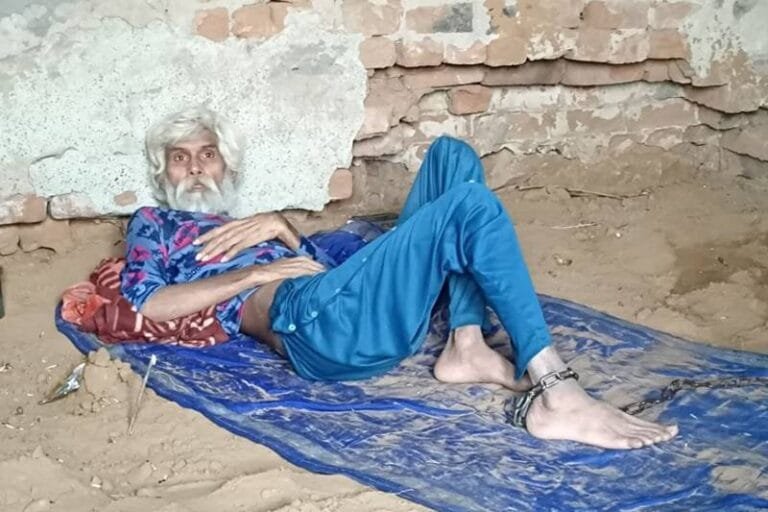
Today, he lives inside a small, crumbling room — more like a broken hut than a home. The walls are cracked, the floor is bare dirt, and his only possessions are a thin mat and a water bottle by his side. His feet are bound by thick iron chains — chains that, his wife says, haven’t been removed in nine long years.
Through scorching summers and freezing winters, he sits confined in this tiny space — a living reminder of how devastating mental illness can be when left untreated and unsupported.
Also Read :




A Wife’s Endless Battle
The Unseen Struggle Caring for Naresh has become the full-time duty of his wife, who shares his name — Naresh Devi. Despite poverty and exhaustion, she tends to him every day.
She feeds him whatever little food they have — often stale bread or leftover vegetables. She bathes him, trims his beard, and handles all his personal hygiene needs within that tiny room. “He is my husband,” she says simply, “and caring for him is my responsibility — just like caring for my parents.”
The family’s financial condition is desperate. There is no male earner in the house. Of their four daughters, two are married and two still live at home. Naresh Devi works as a daily-wage laborer whenever she can find work. On days she doesn’t, the family often survives on scraps.
She describes their life painfully:
“Even animals are sometimes set free, but my husband has been chained for nine years.”
Their grandchildren, who have grown up witnessing this tragedy, have dreams that rise above their harsh reality. Granddaughter Nitu, a class 10 student, dreams of becoming a doctor to help others in pain. Her younger brother, in class 3, listens quietly as his mother struggles to make ends meet. Their childhood is marked by hardship, but also by hope.
Why He Remains Chained
The reason Naresh remains bound is rooted in fear. His illness causes unpredictable and aggressive behavior. When unchained, he tends to wander away, use abusive language, or even hurt others.
His family recalls several instances when he became violent — sometimes harming himself or attacking neighbors. Terrified for his safety and the safety of others, they made the painful decision to keep him confined.
Years ago, they even sought medical help. Naresh was taken to Rohtak for treatment, where he stayed for over two years. But doctors reportedly told the family that his condition was beyond cure and that he wasn’t “safe” to be around others. They advised bringing him home.
This shattered his wife’s hope in hospitals and mental health care. Since then, she has believed it is her fate to look after him on her own.
Her devotion is remarkable — but it also exposes the absence of accessible mental health services in India’s rural areas. The family bears this burden in complete isolation, without help or guidance.
No Government Support, No Safety Net
Perhaps the most distressing part of this story is the total lack of government assistance. Despite their condition and extreme poverty, the family has never received any official help.
Naresh doesn’t even have an Aadhaar card, making him ineligible for pensions or welfare schemes meant for senior citizens or disabled individuals. Without documentation, the family cannot access even basic benefits such as free healthcare or food rations.
In the ten years of their struggle, no government official or social worker has ever visited their home. The family often goes without food, surviving only when Naresh’s wife finds daily labor.
She dreams of a small pension — something that could at least buy them food and medicines. “If we get even a little help from the government,” she says, “I can care for him better.”
This is not an isolated case. Similar stories have emerged from other villages in Jhunjhunu, where mentally ill individuals live in confinement, hidden from the world. It’s a silent crisis — one that reveals how poorly social welfare programs reach those who need them most.
A Wake-Up Call for Authorities
Naresh’s condition highlights a much larger issue — the gaps in India’s mental healthcare and social support systems.
In a country that values freedom and dignity, the image of a man living in chains is deeply disturbing. It challenges the very essence of humanity and justice.
The situation urgently calls for action from government agencies, particularly the Department of Social Justice and Empowerment.
Local leaders, such as Cabinet Minister Avinash Gehlot, who has intervened in similar cases before, could help ensure that Naresh receives his Aadhaar card and a government pension.
These two simple steps could transform this family’s life, easing their financial pain and restoring a measure of dignity.
The Way Forward
Long-term solutions must go beyond individual cases. India needs a compassionate, community-based approach that includes:
- Accessible Mental Health Services: Establish affordable, well-staffed mental health facilities in rural areas.
- Community Support Programs: Offer counseling, caregiving help, and small financial grants to families caring for mentally ill relatives.
- Awareness Campaigns: Educate rural communities to reduce stigma around mental illness and encourage treatment.
- Active Government Outreach: Identify and support vulnerable families who cannot access welfare schemes.