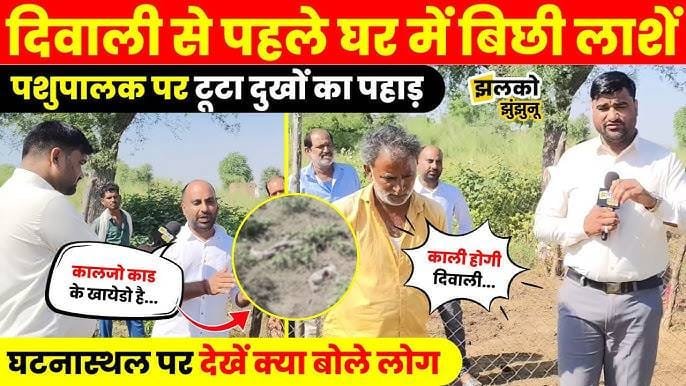
Farmers in Rajasthan’s Jhunjhunu district are facing a growing crisis. Wild animals have been attacking their livestock, causing both financial loss and emotional distress. A recent incident in Bajawa Rawat Ka village has once again highlighted this problem. Just before the Diwali festival, a wild animal attacked a farmer’s herd of sheep, turning his festive preparations into grief and loss.
A Farmer’s Broken Diwali
Parmanand, a farmer from Bajawa Rawat Ka village in the Udaipurwati subdivision, earns his living through sheep rearing. His livestock is his family’s primary source of income — funding daily needs, children’s education, and festival expenses.
However, this Diwali brought tragedy. Around 4 AM, Parmanand discovered that a wild animal had attacked his sheep. Eleven sheep went missing, while six were found dead and scattered across his fields. The remaining five are still unaccounted for.
The incident has shattered the family’s joy. What was supposed to be a festive and prosperous time has turned into sorrow and uncertainty for the hardworking farmer.
What Happened During the Attack
Jhunjhunu farmers news Villagers describe the predator as a dangerous, “blood-thirsty” wild animal — possibly a wild dog or similar carnivore. The animal broke through fences, attacking the sheep viciously and leaving several dead. Its behavior suggests it was determined and aggressive.
Locals rushed to support Parmanand, but his loss is immense and cannot be easily recovered.
Not an Isolated Case
Residents and local leaders say this was not the first attack in the area. In fact, similar incidents have occurred repeatedly across Jhunjhunu. Several communities, including the Bhopa community and farmer Parshu Meena, have reported losing livestock to wild animals in recent months.
Even in Bajawa village alone, four to five similar attacks have taken place recently. These repeated incidents show that this is not an isolated problem but a widespread issue threatening many poor farmers who depend on livestock for survival.
Also Read :




The Impact on Farmers’ Lives
For small farmers like Parmanand, livestock is the backbone of their livelihood. When wild animals attack, the consequences are devastating:
- Loss of income: The animals that could have been sold are gone.
- Future hardship: Families struggle to cover school fees and daily expenses.
- Emotional distress: Farmers feel broken seeing their hard-earned livestock killed.
- Festive sorrow: Diwali, a time of joy, becomes a time of mourning.
Already facing challenges from poor crop yields and heavy rains, these additional losses leave farmers in desperate conditions.
Delayed and Insufficient Government Response
According to local community leader Narendra ji, despite repeated complaints to the authorities, very little action has been taken.
Currently, the process goes as follows:
- Villagers report incidents to the police, patwari (land officer), forest department, and veterinary team.
- A post-mortem of dead animals is conducted.
- Farmers must apply for compensation through the e-Mitra portal.
However, most farmers never receive compensation, even after completing all formalities. This has led to widespread frustration and disappointment. Many feel the government’s system is limited to paperwork, offering no real help on the ground.
What Farmers Demand
Local villagers and affected farmers have made clear demands to the administration:
- Fair and timely compensation so farmers can buy new livestock and meet family needs.
- Permanent solutions to stop wild animal attacks — such as stronger fencing and monitoring measures.
- Serious attention from officials to ensure these cases are treated with urgency.
- Capture or control of the dangerous animal that has been repeatedly attacking livestock.
While the Forest Department has been informed and a veterinary team is preparing for post-mortems, the real test lies in whether these actions lead to tangible help for the affected farmers.