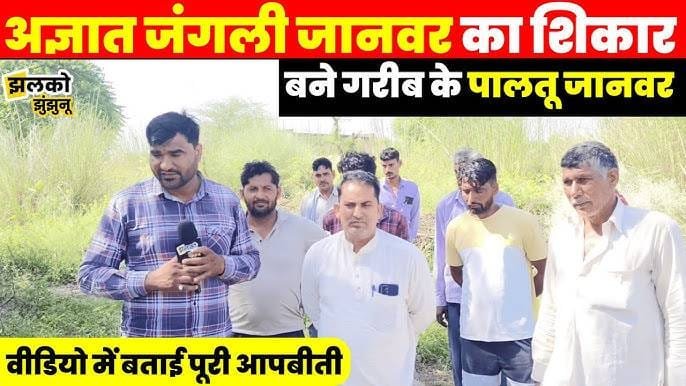
In a shocking incident that has left villagers deeply concerned, an unknown wild animal attacked livestock in Harsawa, a village in Jhunjhunu district, Rajasthan. Several sheep were taken during the night, creating fear and anxiety among the local community, particularly farmers who rely heavily on their animals for livelihood. Local authorities and forest department officials are currently investigating the matter. This report provides detailed insights into the incident, community reactions, and ongoing safety measures.
A Night of Horror: The Harsawa Incident
The distressing event occurred in Harsawa village, where the family of Pappu Ji Meena suffered significant losses. The family rears sheep and goats, which are essential to their income. During the night, a large predator entered their animal enclosure and attacked their flock, taking away five to seven sheep.
The next morning, the family discovered the horrifying scene. Some sheep were partially eaten, while others were killed and left behind. This attack not only caused financial loss but also left the family emotionally traumatized.
Severe Impact on the Family
The Meena family depends entirely on livestock. Both father and son work tirelessly to care for their animals. Losing such a large portion of their flock in one night is devastating.
Also Read :


Wild Animal Attack Jhunjhunu, The attack was particularly brutal. Four sheep were completely consumed, leaving only heads and legs. One sheep was killed and partially eaten, with only its chest consumed. The scale and method of the attack indicate a large and powerful predator. Blood trails were found stretching 150 to 200 meters from the enclosure, showing the animal carried its prey some distance. The scene vividly illustrated the predator’s strength and ferocity.
Villagers’ Fears and Concerns
The incident has spread fear throughout Harsawa and neighboring villages. Residents are worried about the safety of their remaining livestock and even their own well-being. While villagers understand that wild animals can roam freely, an attack so close to human habitation is especially alarming.
Some villagers suspect the predator could be a leopard or a similar large wild cat, based on the way the animals were eaten. The stealth and power of such predators pose a serious threat. With the harvest season underway, villagers have become more cautious, as wildlife often moves closer to villages in search of water and food when natural sources in hills and forests dry up.
Local Administration and Forest Department Response
Upon learning about the attack, the local Sarpanch and other officials immediately visited the site. The Sarpanch acknowledged the seriousness of the incident and assured full support to the affected family. A team from the forest department, along with veterinary doctors, was called to conduct a post-mortem examination on the deceased animals to confirm the cause of death and identify the species responsible.
The Sarpanch also advised villagers to remain vigilant and take preventive measures for their livestock. He emphasized securing animals at night and being cautious during farming activities like harvesting, as wild animals may be present in the fields.
Challenges for Farmers and Livestock Owners
The incident highlights the ongoing challenges faced by farmers dependent on animal husbandry. Attacks by wild animals are often unpredictable and uncontrollable. Poor farmers cannot always afford strong, secure enclosures, relying instead on simple fences or shelters that offer little protection against determined predators.
While government schemes like NRHM exist, not every farmer can access them. Villagers are calling for greater support, such as interest-free loans or assistance for constructing safer enclosures.
Understanding Wildlife Movement and Prevention
Harsawa is situated near the Katli River, a natural habitat and movement corridor for wildlife. During dry seasons or harvest time, wild animals often move closer to human settlements in search of water and food.
To prevent future attacks, villagers are advised to:
- Keep livestock in secure enclosures, especially after sunset.
- Remain vigilant while working in fields.
- Report any unusual sightings of wild animals to authorities immediately.
- Form community watch groups to deter predators.
The Sarpanch hopes this incident does not repeat and encourages residents to take precautionary measures.